23 February 2009

Serengeti!

Serengeti! What mission to Tanzania would be complete without a safari to the Serengeti? The name means endless plain in the Maasai language. And the endless plain is home to countless animals. We excitedly watched a herd of 36 elephants walk around our car. A lone cheetah, spotted in the morning mist on the distant horizon, slowly strolled closer and closer until it crossed the road in front of us and lay down to rest in the shade of a tree not 30 meters from our car. We looked eye-to-eye with a male lion and his entire family group – and understood why it is called his pride.


We didn’t see all the animals of the Serengeti, but we saw enough to make us marvel at the variety of God’s creation. The zebra has his stripes, the giraffe her astonishing neck, and the hippos soak in the pool all day long. Each animal equipped in some special way for life in this marvelous place.

Of course, the birds hold a very special interest for us. Our guide, a most friendly Tanzanian named Ben, was able to show us not only lions, cheetahs, leopards, serval, African wild cat, and a myriad of hoofed animals, but also well more than a hundred bird species. Most of them so new to us that we struggled to find them in the bird book. Often so many appeared at once that we had to look first, and hope we could identify them in the book later. African ground hornbills, lilac-breasted rollers, white-crowned shrikes, fawn-colored lark, cinnamon-breasted bunting, and on and on. Secretary birds that somehow do not remind me of the office. Starlings so striking they are named “superb” – astonishingly beautiful to our American eyes so used to seeing only the boringly drab Eurasian starling. What fun it was!


Two days in the Serengeti makes me want to rush right back. Next time, maybe the wildebeest migration will be in the northwest part of the park where we can reach it easily from Mwanza. Or maybe the cheetah will show off his speed. Or maybe the leopard will change his spots. Or maybe not. Whatever we see the next time, it is sure to be very, very special.

26 January 2009

Peggy's Day At The Makongoro Clinic

I volunteer daily at the Africa Inland Church of Tanzania’s Makongoro Health Clinic in Mwanza. It consists of an out-patient clinic, an in-patient hospital with 29 beds, a mother/baby clinic, and an HIV counseling and testing clinic. My supervisor is Matron Jovina Machia.


Our day starts out with a 20 minute staff devotional time. Along with all the health clinic staff, we sing praise songs, read from the Bible and hear a 10 minute sermon, all in Kiswahili. After devotions are finished we attend the morning meeting with the doctors, the heads from the lab and finance departments, and the 2 matrons (head nurses). We hear the night report, and discuss any concerns that have come up, again, all in Kiswahili. Then Monica and I dispense any medications that are needed that shift for both the out-patient clinic and the in-patient hospital.


When the meds are finished, Monica (the other Christian Reformed World Relief Committee nurse volunteer from Canada) and I usually go to work in the hopsital wards. Soon one of the doctors comes by to do rounds. We go as a group from bed to bed while the doctor speaks with each patient about how they are doing. Still, all in Kiswahili. Then the doctor makes the orders for that day, but now in English! All the patient charting is in English, and the written orders are, too. So the Tanzanian nurses love to have us do the writing in the Rounds Book, because it has to be in English!

For the rest of the shift, we work alongside Tanzanian nurses. We often dispense medications, usually intravenous quinine for the treatment of malaria. And we admit new patients, again usually with a diagnosis of malaria.


In the hospital there are three large rooms or wards, one a children’s ward, the second the women’s ward, and the third a men’s ward. There is also one “private” room with 2 beds and a private toilet. The rest of the patients share common bathrooms (one for the men, one for the women and one shower).


The hospital is on the same compound that we live on, so it is only a 2 minute walk to work. Except that on the way we must greet every person we meet. Near or far, we must ask “Harbari za asubuhi?” (“News of your morning?”), and “news of your home,” and “your family,” and “your work,” and “Mama (or Baba) hajambo?” (“Mama has no problems?”). And then we walk on until the next person we see and go through the greetings again. It is a very fun ritual, but it slows down our walk a lot. Fortunately, even our boss understands that being late sometimes cannot be helped!

16 January 2009

Gordon's Work at AICT


This year Africa Inland Church of Tanzania (AICT) is celebrating its 100th year. It was started in 1909 by missionaries from America, called the Africa Inland Mission (AIM), which is still active in Africa today. Sixty years after its founding, the AIM turned over the ownership and supervision of the Tanzanian church to local leaders, and AICT was formed. The two organizations have been operating in partnership in Tanzania ever since.


The AICT church has about 1,000,000 members. They are spread across Tanzania, but concentrated in the northwestern part of the country where the church began. I (Gordon) am volunteering at the national headquarters under the direction of General Secretary Joseph Gisayi. I have my own office, which I share with a couple geckos and a few cabinets full of records. Lately I have been reviewing five-year plans. First the strategic plan for the entire national church. Next the strategic plan for the health department. The plans are written in English, so I am able to offer many editorial suggestions to help clarify the text and intent of the plans. Soon I will be reviewing plans for other departments of the church, like the publishing department, the finance department, and others. The health department plan is already finished; all of the others are presently drafts, or not yet even written. The church is in the midst of an intense planning process to focus its strategy and operations in accordance with its vision and mission. In summary, AICT’s mission is to spread the Gospel of Jesus to all people and to promote holistic human development to help the poor achieve major improvements in their mental, physical, and spiritual growth and development.


The five-year plans of the church are impressive, as are its existing operations. It already operates a theological college, two successful secondary schools, a nursing school, two large hospitals, two health centers with small inpatient wards (about 30 beds each), and 18 smaller health dispensaries, along with many other programs. But with much still needed to be accomplished in Africa, its five-year plans focus on improving and expanding its operations, not only to increase spiritual care, but also to contribute towards sustainable and affordable access to quality social and economic services (health, education, agriculture) for the people of Tanzania, with particular focus on the poorest communities and those affected by disasters. Among the goals AICT seeks are improvements in access to safe water, increased education for village children, HIV/AIDS counseling and education, improved agricultural practices, and greater justice and gender equality for women. Interestingly, it has chosen significant reductions in national infant and maternal mortality rates as the primary indicators of success for many of its food, health, and sanitation goals. The church recognizes that it cannot accomplish such significant changes by itself, so it expressly states that it plans to contribute to the work of the national government and other churches and NGOs in achieving these goals.


I still have much trouble understanding Swahilli, but it did not take me long to understand, even in Swahili, that the church in Tanzania believes in the power of prayer. If you will, please pray with me that the plans and work of the AICT will, along with that of its partners, be effective to improve the spiritual, mental, and physical condition of Africans in Tanzania, both now and for many years to come. As they say in Swahili, tuombe -- let us pray.

04 January 2009

Lunch

Several days a week we share lunch with a Tanzanian family in their home. We start by washing our hands in warm water poured from a pitcher into a bowl by one of the children. After prayers we are invited to eat a simple, but well-prepared meal. The staple of the lunch is ugali, (a thick corn meal) or rice. Also there is a cooked green and a bit of meat -- kuku (chicken), n'gombe (beef) or samaki (fish) -- cooked in a sauce. The ugali is dipped into the sauce and eaten by hand. Our inexperienced fingers have some difficulty getting the ugali to our mouths without it crumbling to bits and without the sauce dripping down our chins. We enjoy the tasty food and, especially, the experience of sharing the meal with the children of our host family. Our attempts at Swahili conversation with the children and our host are sometimes very amusing. Like the day Peggy tried to tell the mama the food was good by saying "chakula ndege," which translates as "bird food" instead of "good food." Another day Gordon was taking a picture of the family and got them all to smile by loudly saying "chapati" (it means "chapati"), which made them all laugh. Now when the kids see Gordon across the grounds they wave and shout out "Chapati!" And that makes him smile.

28 December 2008

Gordon's Ant Story


This entry is from Gordon's personal journal, December 3, 2008.


I have to mention the ants. Maybe 10,000 of them. Or a billion? Who knows. They are making good use of the house, and I am guessing they live in the attic. Little brown ants. Marching in neat lines. Up and down the walls. Across the floors. Always searching for the smallest crumb of food and throwing a big ant party when they find one. But what are they looking for on my computer screen? Give them a shot of Doom, and they just find another route to follow in their quest. Aside from the nuisance of just being there, they seem harmless enough. Not like those large black ants I wandered into yesterday. I was just exploring the back yard when I found myself about a step from an interesting ant hill. The same time I discovered the ants, they discovered me. Wow, did I jump. They have a serious bite. First my foot. Then again. Then my leg. Then both legs. Ants in my pants! And still climbing up. I ran to the house, slapping my legs as I went. In a few strides I reached the door, ripping off my sandals. But ants continued biting my feet and legs. Off came my pants, and frenzy happened until all the ants on my feet and legs were dead. Much to my relief, they never reached the critical height of my underwear. My sandals on the step were still under attack by a dozen more ants. Somehow without getting bit herself, Peggy killed them and the ants still looking for me in my pants. I respectfully left those pants hanging for hours before I dared put them back on. I am so glad these were biting ants and not the stinging ants. At least the pain ended when the ants died. Siafu they call them. So watch where you walk, because not all ants are the same.


Ant Update. December 29. Although there are still minor skirmishes with the little brown ants in the house, I have declared victory. When they do send a patrol to investigate, which is not often now, they number only scores, or maybe hundreds at the most. A little well placed ant dust (well, lots of it actually) has brought them to their knees. As for the biting siafu ants, I still dare not venture into their well-defended domain. Take a look at the picture of the siafu and you will see why.

26 December 2008

Christmas in Bulima Village

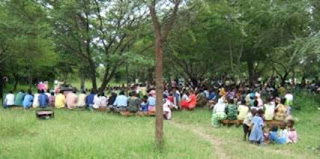
We just returned from five days in the village of Bulima with a number of new friends. The drive took about one and a half hours on a good road. Christmas morning six of us walked down to an outdoor church service attended by hundreds of Tanzanians and six westerners. A choir competition had just ended the day before, so we were treated to singing and dancing by four different choirs. The pastor spoke about the example the three wise men show us: to seek out Jesus, to worship him, and to give him our best gifts – from our hearts. It was all in Swahili, but a Wycliffe worker in our group was able to translate the essence for us. We enjoyed the three hour service very much.

Christmas evening a group of 14 gathered for dinner and fellowship in the home of an instructor at the local Nasa Theological College. We were 1 Briton, 3 Germans, 4 Americans, 4 Canadians, and 4 Tanzanians. For most of the non-Tanzanians, this was our first Christmas in Africa. We shared many foods, including delicious roast goat and a dish common to most of our dinners in Tanzania – the best fruit compote available anywhere. We sang Christmas carols and three men shared reflections on different aspects of the Christmas story. Gordon chose to reflect on John 1. Our thoughtful two host families had gifts for each of us. Two things were especially touching about the gifts – the reaction of the two young Tanzanian boys (residents of the Children’s Rescue Center in Mwanza) to the gift of shiny new black shoes and the gratefulness of the young women whose Christmas packages had been permanently lost in the mail.

We are still adjusting to the many differences in the local culture, so we really appreciated the mix of the familiar and the new. It was a memorable Christmas, illustrating to us how much the Christmas story means to people of all cultures all around the world. Merry Christmas to all our friends, old and new.

17 December 2008

Our Neighborhood

We live in a home on the Mwanza compound of the Africa Inland Church of Tanzania (AICT). On the many acres of the compound are located a large church building, the offices of the Mwanza Diocese of AICT, and the national headquarters of AICT (where Gordon volunteers). Only a few steps away from the national headquarters is the AICT Makongoro Health Center. There Peggy volunteers alongside the Tanzanian staff and another CRWRC volunteer, Erin Carter from Canada. Occupying several buildings, the health center includes an outpatient clinic, a 30 bed short-term inpatient unit, an HIV/AIDS counseling and volunteer testing clinic, and a mother and baby clinic. There is also a guest house where short term visitors can get lodging and a restaurant for simple Tanzanian fare. Other buildings on the compound house a computer support and training center, the technical support department for maintaining clinic and hospital equipment, the Christian education department, missionary support, development, and other AICT church offices. And finally there are several residences. Most of the homes are used by AIC pastors and staff members, but two houses off in one corner are homes to us and our friend Erin. From there our commute to work is about 2 minutes on foot.