15 September 2014

Four-Thirty!

15 September 2014. This year September started with a bang at 4:30 AM. Then another! And another! Every four seconds another! Until there were 24 in all. There was no going back to sleep after that, so on September 1 we got up at 4:30 AM.

The next day began with a big bang, too.  It was 4:30 AM. Then another. And so on. Not the 24 blasts of the previous day, but 5 or 6.

La Virgen de la Merced
The next day – you guessed it! More big bangs starting at 4:30 AM. In fact, so far EVERY day in September has started with loud fireworks—like cannon shots—at 4:30 AM.

“¿Por qué hay bombas cada mañana a las cuatro y media?” I asked my Nicaraguan friends. It turns out that September is the holy month for La Virgen de la Merced (the Virgin of Mercy), patron saint of León. Many local Catholics pray for her intercession and believe she protects the city in times of catastrophe. The fireworks, they say, will continue every day all month. And there will be a special (meaning bigger and louder) celebration on 24 September, the patron saint’s holy day.

Iglesia de la Virgen de la Merced, Leon
And where do we live? About 250 meters from Iglesia de La Virgen de La Merced. Yes, we live just up the street from the Church of the Virgin of Mercy. Even though I am hard of hearing and sleep with my good ear against the pillow, I never miss hearing a single 4:30 shot. Today we are half way through the month. Fifteen days down, 15 more to go. I won’t need an alarm clock until the first of October.

Flags of Central America


But in León there is more to fireworks in September than just La Virgen de la Merced. Today is Independence Day. On this day in 1821 Nicaragua and all of Central America were granted independence from Spain.

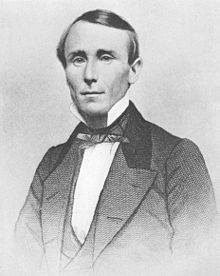
And yesterday was Battle of San Jacinto Day. On 14 September 1856, a battalion of Nicaraguan soldiers defeated the mercenary army of William Walker, a US adventurer and the self-proclaimed President of Nicaragua who was trying to open up the country to settlement by North Americans. It was the beginning of the end for Walker's army. Ever since that day valiant struggle against imperial-minded interveners from the US has been a potent political image and a source of swelling Nicaraguan pride.


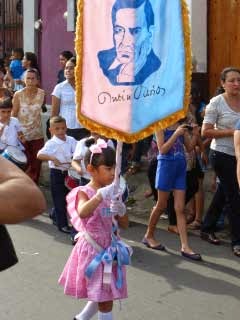
The combination of those two holidays makes this the most patriotic time of the year. Parades of hundreds of marching children (pre-school through high school), colorful fiestas, thousands of people enjoying the celebrations. 

Here are some scenes from the parade.

Thousands Along the Parade Route

Top Student -Ruben Dario Preschool
A Preschool Drum Corps
It was a busy and noisy holiday weekend in Leon. But today, a legal holiday, it is quiet in the city. No one is working, no students are at the universities, the normally busy medical clinic across the street is closed.

All is quiet. Until 4:30 AM.

15 August 2014

Connecting With History

Friday morning, León, Nicaragua. My faithful reader noticed the other day that I haven’t written on this blog in a long time. “Where have you been?” is his question. As I reflected on this question, it struck me that the last few months I’ve spent connecting with history. 

To celebrate our 40th wedding anniversary Peggy and I took a big trip – The Birds and Culture of China. There we saw many astonishing things from China’s distant and not-so-distant past. Near Beijing we walked on the Great Wall – the immensity of it is awe-inspiring. Built a couple thousand years ago, without the benefit of a single piece of motorized machinery, it winds along rugged ridges from hilltop to hilltop more than 5,000 miles, a distance much greater than that from Michigan to Alaska. How did they do that? What was life like for those construction workers? For the soldiers that manned the remote stretches of wall? Did it keep the warring barbarians out?

Near Xian we visited the Terra Cotta Warriors – life-sized warriors, horses, chariots, archers – an entire army of 8 thousand or more, each with a unique face.  They were made of clay a couple thousand years ago and buried with the emperor who first united the warring tribes of China. It was certainly a great and impressive send-off into the next life for him – and I’m guessing his real army was quite relieved to have been substituted for by the terra cotta replacements at the last minute.

What I saw in China, both ancient and modern, gave me the distinct impression that China doesn’t do anything on a small scale. When they undertake a public project, it’s not just big—it’s enormous. One could legitimately ask if China can keep up the great pace of development it is undergoing today. But in response one would have to acknowledge that China has a several thousand year history of progress and grand developments. I had the impression (from high school history?) that in the 19th and 20th centuries China was a rather backward nation compared to the western powers. But now I have the impression that China’s seeming backwardness was just a temporary 2 century interlude in more than 20 centuries of significant advances in culture, science and technology.

Of course there were birds to see in China, too.  We saw lots, including some extremely rare birds.  Two species, Crested Ibis and Siberian Crane, until recently thought to be extinct, and another, Jankowski’s Bunting, which may become extinct soon. China has some beautiful forests and nature preserves, but it also has big environmental problems. Industrial and domestic pollution is widespread and habitat loss is severe in places.  China is certainly not unique in this respect. God did tell us to be fruitful and multiply, and he gave us the earth to provide us the things we need to flourish—but we must remember that God never told us to ravage the earth and destroy it.  The world, and everything in it, belongs to God. We should treat all of creation with care and respect as the valuable property of another who has entrusted it to us for but a season. It would be a shame—shame on us—if we continue to wipe out plants, birds, animals, and other creatures that God gave us to enjoy life in abundance.

Three months after China we made a short trip to Peru to visit our son and daughter-in-law who were there for her brief internship. We went straight to the center of ancient Inca civilization: Cusco, Ollantaytambo, and Machu Picchu. At Machu Picchu I was again struck by the immensity and craftsmanship of this ancient city, built high on a mountain to help fend off attacks of wild animals or fierce enemies.  It’s not so hard to imagine why they built the city although it amazes me that they could build it where they did. But why did they then abandon it suddenly near the time of the Spanish conquest and after only 150 years or so of occupation? The city was never conquered—it wasn’t even discovered by outsiders until the early 20th century—so conquest by Spain is not the answer. At least not directly. Machu Picchu is a place full of mystery.

At Machu Picchu I thought about the designers, engineers, inspectors, and construction foremen who directed construction of the city. How did the designers and engineers communicate the design specifications to the work crew? They had no written language. I’m guessing there were no blueprints or design drawings to follow. Yet when you look closely at the carved stones that comprise the most important buildings (usually temples), they display an intricate structural design that was executed with incredible precision. The walls are not made of simple rectangular blocks of stone, but rather of multi-surfaced complex shapes that fit together like an intricate 3-D puzzle. The joints between the huge stones are so tight you cannot slip a knife blade between the stones (no, I didn’t try that!). And they were all carved by hand without even iron tools for the job. How did they do that? Looking at Machu Picchu made me reassess my own ideas about how organized and capable ancient civilizations, like the Incas, must have been. Surely this was a complex and intelligent society that did simply amazing things with such tools as they themselves had discovered and made.

After a few weeks visiting family in the US (connecting with our family history again), we are now back in our León, Nicaragua home. Here we find that the expected rains of the season are both late and meager. Consequently, it is unseasonably very hot and, more significantly, many small farmers are in or near crisis mode for lack of water. We pray for more rain before it is too late for this season’s crops.

Connecting with history continues to be our central focus here in León. In just five weeks we begin our new mini-careers as professors of Nicaraguan history.  Of course, before you can teach you must study. So we are now studying Nicaraguan history ourselves. Nicaragua doesn’t boast a great center of a powerful ancient civilization, like China or Machu Picchu (and I wonder why). Instead, the recorded history of Nicaragua seems overwhelmed by outsiders—beginning with the Spanish conquest, followed shortly thereafter by 150 years of episode after episode of US involvement and intervention in Nicaragua’s internal affairs. Understandably, today Nicaragua is still trying to find its own way after nearly 500 years of excessive foreign influence—which may not be finished yet.

Well, that’s just a taste of what we are learning. If you want to know more, sign up for the history class. There you would join 8 college and university students in a semester abroad program sponsored by Dordt College in Iowa. The students will be arriving in country in just 2 weeks, so if you are going to join them, you better pack your bag soon.

03 April 2014

A Walk Through La Limonada

March 21, 2014.

The Nicaraguan Cohort of Missioners has been working together through the book Geography of Grace.  A central point of the book is that the grace of God pools up—is most evident—in the lowest, most needy places.  Today we and the Cohort visited one of those places.  La Limonada is a barrio, some would say slum, in Guatemala City.  At the outskirts of La Limonada we were met by Tita who would spend the next few hours walking through the barrio with us. 

Once a wooded ravine, green and natural, it is now gray and dense with the poorest of the poor of the city.  Over a period of many years the ravine was occupied by squatters seeking refuge from war and displacement, and now it is a labyrinth of simple cinder block homes, built wherever one could find space.  The shape of the home is dictated by the shapes of the homes that surround it.  Now the only open spaces in the ravine are the pathways that wind in labyrinth fashion among the tiny homes.  Often so narrow that a motorcycle and a pedestrian cannot pass side by side, the “streets” twist and turn erratically, passing by the doors of homes and workshops every few meters, ultimately ending at the front door of the last home on the street. 

La Limonada is home to thousands of people.  It is also home to much crime and violence.  As we walked by one tiny church, Tita pointed out the bullet holes from some distant gang fight, still evident in the front wall.  We visited and prayed at one home where a young man lay in his bed, still suffering from a bullet wound he received 5 years ago. Violence, like the shortage of physical resources, is a fact of life in La Limonada.

But more about Tita, our guide for the day.  She is a Guatemalan with a heart as big as all of La Limonada.  She focuses not on what La Limonada doesn’t have, but rather on what La Limonada does have.  Walking with her in La Limonada is like walking with a rock star, only better.  Children ran up to her on the street shouting “Mama Tita! Mama Tita!”  She had a hug for everyone, and even “cool” teenagers let down their guard for a moment to give her a hug.  People would greet her in their doorways, and within moments Tita would be inside their homes, encouraging them and praying with them and for their problems.  We walked into homes where residents were making shopping bags or teaching others to make beautiful slippers, all to sell in the market.  It is so obvious that she loves the people of La Limonada, and they love her in return. 

A movie was made in 2010 about the work of Tita and others in La Limomada.  It is called Reparando and available for rent or purchase here: http://www.amazon.com/Reparando-Scott-Owen-Moore/dp/B00EWGYL8A.  Walking through the barrio today, the people we once saw only in the movie came became very real to us.  We had our picture taken with a smiling Guis, the once solitary man whose life, through the love of Tita and others, has undergone profound changes.  We stood and prayed in his room with Vitalino, the old bed-ridden man, cared for by his neighbors for 7 years now, whose birthday party was shown in the film.  It was humbling to walk and pray side-by-side with those who have poured out so much love into La Limonada.  Today we saw that the grace of God does indeed pool up in the lowest places, bringing change and hope to what was once considered hopeless and unchangeable.  

04 February 2014

Travels of a T-Shirt

We north Americans seem to have a thing about T-shirts.  Most of us have several, some of us have dozens.  And they aren’t just white undershirts—they make statements!  Over time you can learn a lot about a guy just by noticing what his T-shirts say. 

But who would have thought the actual life history of a T-shirt would be so interesting?  I just finished reading a book that my son gave me for Christmas:  Travels of a T-Shirt in the Global Economy: An Economist Examines the Markets, Power and Politics of the World Trade by Pietra Rivoli.  I loved this book.  By examining in detail the story of the humble cotton T-shirt, this book told me everything I didn’t know about the global economy—and I really didn’t know much, it turns out.  I learned about cotton seeds and ginning, about slavery, about Texas cotton research, about price supports, about the global race to produce the cheapest cotton shirts in the world, about world markets, and about the incredibly, arcanely, highly regulated “free trade” import of T-shirts into the U.S. from China, Burma, Nicaragua and just about anywhere.  I learned that those imported T-shirts are made from the same raw cotton that had been exported from the U.S. just months before. 

This book is about the process of making money in the cotton industry, but it’s also about poverty.  It’s about incredibly hard work for long hours in underpaid sweatshops, but work that also provides a path off the rural farms and out of desperate poverty for thousands upon thousands around the world and over the centuries.  To think of the sweatshop as a gateway out of poverty was a mind-bender.

Before I started reading the book I told my son I hoped it would include a discussion about the sales of used T-shirts in Africa, a phenomenon I personally witnessed in Tanzania. I was not disappointed. To me this was perhaps the most interesting part of the T-shirts’ travels—how barely used T-shirts make it from suburban closets to the open air markets of Africa and all the steps in between. When I was in Tanzania, I thought “what a shame, the sale of used clothing from America has driven all the textile makers of Tanzania (if not all of Africa) out of business.” That’s what I thought then. But after reading the book it’s not so clear. There are many factors that “drove” the textile business out of Tanzania, not the least of which would certainly include (to mention just a few reasons) the lack of cheap and reliable electricity, corruption at all levels, and, very significantly, U.S. trade laws and policies governing the import of cotton clothing. Did you know that as recently as 5 or 10 years ago there were regulations about where the cotton came from that was sewn into the pockets of men’s pants imported into the U.S.? But the import of really cheap used U.S. (and European) clothing has had a positive effect in Africa—villagers who once had nothing but rags to wear (because local suppliers couldn't meet demand at low prices) can now wear colorful, quality clothing bought at very inexpensive prices. And while there aren't many cotton growers or textile factory workers left in Tanzania, there is a whole new crowd of entrepreneur merchants in the clothing business.

Travels of a T-Shirt is not an economics tome, nor does it “preach” about the evils of the T-shirt industry.  It just tries to tell the story and let the reader draw his or her own conclusions about global trade.  It will inform, and it will make you think.  It is eminently readable.  If you want to learn a lot about globalization and its effect on poverty, read Travels of a T-Shirt.  

07 November 2013

Dengue Fever

7 November 2013.  Nicaragua, including our own city of Leon, is currently suffering from an alarmingly high incidence of dengue fever.  This mosquito-born illness is very serious, so mosquito control is a high priority in Leon these days.  Here is a picture of our street taken just as the insecticide fogger was finishing the treatment of our house.  The fog coming out of our front door was so intense it stopped traffic in the street!


06 November 2013

Casas de Justicia

The World Renew evaluation team visited the CCDH (Christian Center for Human Rights) local office in Matagalpa.  Each of the CCDH local offices is called a Casa de Justicia (House of Justice).


I stopped to take this picture of the sign at the office door and noticed that a final "A" is missing from the end of Matagalpa.  "There wasn't money in the budget for another A" they explained.


Then we visited the Casa de Justicia in La Dalia.


Followed by a visit to remote El Cua, where the CCDH office was jammed with clients and justice promoters. 


And finally we visited all the Casas de Justicia (there are 3!) in Jinotega.  These women are the lawyers who do all the legal work and guide the non-lawyer promoters. 
.


Volcan Masaya -- Be Careful Where You Park!

On October 27 we visited Volcan Masaya with Sue Carlson and Luke Theule.  They had come to Nicaragua to assist in World Renew's triennial evaluation of CCDH (Christian Center for Human Rights).


Volcan Masaya is very active.


It is constantly emitting steam and sulfurous gases.


You can drive right up to it in your car.


Just a couple years ago it burped out some boulders that crushed a car in the parking lot, so we can no longer park at the caldera's edge.  Instead we have to back in about 50 meters away so we can be ready for a fast get away.


I was sad to have to return the hard hat at the end of the visit

03 October 2013

Caught Between a Cow and .... WATCH OUT!

3 October 2013. On Monday Peggy and I were driving back from Managua to León after a day in classes with the Dordt College students.  Two Nicaraguan passengers were in the car with us. We were going up a long and winding grade on the two-lane road.  Ahead was a tractor trailer rig going about 65 kph, slow but not crawling as is often the case.  Behind us was another tractor trailer rig who clearly wanted to go much faster than 65.  I was sure of that because I could read his Honduran license plate in my rear view mirror.

As our tight little pack came around a blind curve I instantly knew there was going to be trouble.  A cow was walking into our lane from the right shoulder.  The truck ahead of me braked quickly and pulled to the left.  I braked and looked in my rear view mirror.  Clearly I was not going to hit the cow, but it wasn’t clear that the massive truck behind wouldn’t roll right over us.  In the mirror I saw billows of smoke coming up from his tractor tires as he braked really hard and veered to the left.  WE were the biggest obstacle in his path.  I saw an opening -- I accelerated and jerked to the right, escaping onto the shoulder.  Thank God there was a safe shoulder right there, because more often than not there isn’t on these roads.  The truck in front continued on.  We zipped around the cow and back onto the road without even stopping.  The tractor trailer behind us had the most difficulty of all recovering from his evasive maneuver and still dealing with the cow who continued in his direction.  Well, we all survived – even the cow. As soon as the road and traffic allowed I passed the slow truck ahead of us and sped on, hoping to never see that Honduran plate in the rear-view again.

Gracias a Dios.

03 September 2013

Students, Cohorts and ... Professors?

3 September 2013. We’ve been really busy the last few days.  You wouldn’t know it from reading this blog, of course.  From the blog it looks like we’ve been totally absent for a couple months—which we were.  For 8 weeks we visited family, friends and our church in North America and generally took some time off.  In that time we studied no Spanish, breaking our self-made promises to do so.  But, so I told myself, I was letting all that Spanish I had learned earlier sink in.  And that turned out to be quite true, as much of it has sunk so deep that I can no longer dig it up.

Anyway, now we are back in Leon.  This past weekend 7 Dordt students arrived.  They are taking a semester abroad to study in Nicaragua.  They’ll be living in Leon, and we’ll be somewhat involved in their program. Part of our volunteer responsibilities is to offer them a place to drop in from time-to-time (like the 3 sitting in our living room now), some mentoring, and a weekly time of pizza and spiritual discussion using Geography of Grace by Rocke and Van Dyke (a recommended read, for sure).  But more than that, we (both Peggy and I) are going to be attending their History and Culture of Nicaragua class and assisting Professor Joel Huyser as discussion leaders.  The plan is that we will take over full responsibility for the class next year.  This is going to push us a bit. 

For the last few days the students have been involved in orientation and moving into their new Nicaraguan host family homes.  Now they are finally settled in and starting classes today.

At the same time, a Missioner Cohort arrived and is settling in to her host family home.  This young woman is Nicaraguan, but has been living in Costa Rica with her mother for the last 6 or 7 years.  Our other Missioner Cohort is a young man from Michigan.  He arrived earlier and has been studying Spanish since June.  

You must be asking, What is a Missioner Cohort?  This is a year-long volunteer position offered by the Christian Reformed Church to folks who want to live in an intentional community of spiritual study, prayer, work and play to support the community of Christians in León as they (the Leones) seek to better engage their neighbors. The Missioner Cohort opportunity is brand new, and we are charged with helping to make it work well.  It’s a good chance for folks of all ages to experience what cross-cultural ministry is like in a developing world context while growing in spiritual discernment. You can find out more about it here:  http://www2.crcna.org/pages/servicelink_intNIC_cohort.cfm


So our formal Spanish study has ended, and now we are feeling our way forward not only in our Spanish language and Nicaraguan culture adventures, but also in this new multi-faceted role of walking alongside these 9 students and missioners.  We are excited about the prospects and not a little intimidated about the challenges, especially this future “professorship” of Nicaraguan History and Culture.  But, we have already started reading.  It’s like going back to school ourselves, but with a much different perspective.   

03 June 2013

Cloudburst

3 June 2013.  After living in León for five months with barely any precipitation, it has finally begun to rain hard.  Just a few nights ago we were enjoying dinner with a couple friends in our neighborhood Mexican restaurant.  Can you imagine the temptation of living less than a block from your favorite Mexican restaurant and less than 2 blocks from your favorite pizza restaurant?  We have become regulars.  But back to the rain.  It began with bangs of thunder and within seconds it wasn’t just rain, it was a cloudburst.  For a few minutes the sound of the rain hitting the roof was so loud we had to shout to be heard.  As the rain continued, we relaxed, enjoying the fresh scent and the instant coolness brought by the rain while we waited for a break in the cloudburst so we could walk home.

When that break finally came, we made a dash for home.  But when we got out on the sidewalk we could see the streets were filled and gushing with water.  It could have been a delight to wade into it, but all I could imagine was how dirty it was.  The torrent was carrying away all the city’s accumulated dirt, litter, filth and, well, let me just say the leftovers from all those cart-pulling horses that use those same streets every day.  I was actually fearful of what might contaminate me if I stepped in the water. 

But we were committed, and when we found the spots where the water flowed the shallowest, we waded in and crossed over the streets.  In a minute we were home, refreshed from the rain and the adventure.

I’ve been thinking about that.  It struck me how the cloudburst and the rush of water was like the grace of God that rains from heaven.  About how there is so much grace gushing out that it is sufficient to wash away all of the accumulated trash, filth, and decaying things of a whole city—even the whole world.  And when the city has been washed clean, it is freshened by that very same grace and prepared to sprout new grass and leaves, to become verdant, to produce new life in abundance.


In our church baptism, a symbolic outpouring of God’s grace, is done with a sprinkling of water.  But the next time I see a baptism, I will be thinking of this cloudburst.  How the water gushed in such abundance that washed away the entire accumulation of filthy stuff and left the city not just clean, but also renewed and ready to spring forth in abundance.  That’s an image of God’s grace that I will remember.  

06 April 2013

Subtle Changes


Last night as we walked home with our to-go pizza from Antonino’s Pizzeria we got a little wet in the rain, the first rain we have felt since we arrived in León in November. It lasted less than 30 minutes, but it was refreshing.  So refreshing that when we got up this morning and went into the garden, the fresh air felt a little chilly at 27 degrees centigrade.  Chilly at 27?  Good grief, that’s 80.5 fahrenheit.  We have begun to acclimate, and just in time.  They say April is the hottest month here in León.

Another subtle change is happening.  I did not notice it coming, but suddenly I saw it one morning this week as we walked to our Spanish school. When we rounded the corner and turned westward, it struck me that the pedestrians were no longer all walking on the south side of the street.  They were walking on both sides of the street.  As they always had done before, all the people were still walking in the shade of the buildings.  But now the shade is distributed almost evenly on both sides of the street.  Of course!  The spring equinox just occurred a couple of weeks ago, and the sun now appears virtually overhead, north of the equator for the first time since we moved to León.  Soon we’ll all be walking on the same side of the street again—the north side.

10 March 2013

The Last: Bat Falcon


8 March 2013.  The last half day of birding at El Jaguar (more than a week ago already) brought us 3 new Nicaragua species and 2 more life birds.  The Strong-billed Woodcreeper looks like a giant-on-steroids version of North America’s Brown Creeper, but my favorite bird of the trip was the last lifer, Bat Falcon.  A stunning black, white, and orange bird, this small falcon zoomed through the sky like an aerobat, catching and eating insects and—was that a bird it just ate?—other creatures on the fly.  For a moment I thought the falcon was a white-collared swift, but no, it was bigger and had those cool looking orange legs and belly that flashed at us when it banked the right way.  It flew around and around above the openness of the coffee plantation, giving us plenty of time to enjoy the show.

In all we found 15 new life birds and another 23 new for Nicaragua.  With so many others remaining on the reserve's list, we left El Jaguar with lots of reasons to go back again someday.  The fact that the chigger bites did not exceed the total number of new birds was an added bonus.

By the way, if you shop at Whole Foods in the US, you can buy El Jaguar's coffee.  It is sold under the Allegro brand name and is labeled "Nicaragua El Jaguar."  If you try it, you'll be drinking the same delicious and bird-friendly coffee we heartily enjoyed during our stay at El Jaguar.  The birds will thank you for it. 

Los Pinos


Today we visited Los Pinos, the pines, north of San Rafael del Norte.  The terrain was much like the pine-oak habitat of southeast Arizona, but rather more open because the land is used for cattle grazing.  It seems most of the green and black warblers of north America like this habitat.  We saw Hermit, Townsend’s, Black-throated Green and Grace’s warblers, all in the pines.  We missed the Golden-cheeked, but it’s sometimes found there, too.  Other birds were the highlights of the visit, though.  Black-headed Siskin, Ferruginous Pygmy-Owl (for Peggy), and Lesser Roadrunner were the lifers.  Later, at man-made Lake Apanás, we found a group of Grassland Yellow Finches for the last lifer of the day.

We have one more half day of birding here at El Jaguar.  We clearly aren’t going to make my goal of 25 life birds, but we already have 13 and that is quite respectable I think.

The Chlorophonia Show


24 February 2013.  In two days of birding at El Jaguar we haven’t seen as many life birds as I had dreamed, but we have certainly seen enough to keep our spirits high.  So far we have seen 9 life birds and another 11 species we had not previously seen in Nicaragua.  Not bad at all.  

The most fun today were the very small Blue-crowned Chlorophonias, 3 of them, seen very high in the forest canopy sitting in a little window of direct sunlight in the lowering late afternoon sun.  Their lemon yellow bellies and fluorescent green heads and wings glowed neon-like in glorious contrast to the shadows cast by the leaves surrounding them.  The show of light and color was especially satisfying because we already today we had twice missed seeing this species, and we only found this threesome by craning our necks and scanning the canopy for many minutes, searching in the general direction from which we heard their cooing song.  As each of us finally fixed on the birds, each in turn “wowed” at their brilliance.  They were, quite literally, the highlight of the day

The Subjunctive Holiday


23 February 2013.  We are making progress.  I’m just sure of it.  We have to keep reminding ourselves – we’re making progress.

This afternoon I am sitting on the porch of our cabin for the weekend.  We are in El Jaguar Private Reserve, where they both grow shade-grown coffee and cater to birds and birders.  There is no internet here, so it will be days before this gets posted.  I am looking out over a narrow valley.  On the down slope in front of me are coffee plants, banana trees and flowers.  On the opposite slope is a beautiful forest.  It’s quiet now, all the birds are taking siestas, too. 

We are taking a holiday from our studies.  For the last five weeks we have been hitting the Spanish hard.  Trying to learn, understand, and remember the subjunctive tense has been making us tense.  It has not been an easy time lately, but we are our own worst problem.  We talk to each other in English instead of Spanish.  But I have to say, after 4 hours of class each day I need a nap, and then when I’ve finally finished my homework, I really feel ready for bed.  It seems the only relaxation time we have is when we speak English.

But I know we are making progress.  When we arrived at El Jaguar, we spoke several minutes with the young man who greeted us before we learned he speaks a little English.  He will be guiding is in our birding the next few days, and I think it may actually be easier for us all to communicate in Spanish.  At least as long as I’m not required to express my thoughts and desires in the subjunctive. 

We already have one life bird for the day, Plain-capped Starthroat—a hummingbird.  The bird list for the preserve includes as “common” 37 more species that would be lifers, plus another 22 that are merely uncommon.  Let’s see, if we see only 40% of the common and uncommon life bird candidates, we would have seen (this is in some kind of subjunctive, by the way) about 24 species.  And we are also going to visit some other spots that feature other interesting new birds.  So I think an ambitious target of 25 sounds good.  Only 24 more to go.  Time to hit the trail.

29 November 2012

More Reflections -- No Hammock


29 November 2012.  My attitude today seems just right for an afternoon in a hammock, but alas we don’t have one in our rented apartment in León.  So these following, unconnected thoughts are what I would have reflected upon from the hammock this afternoon.

I counted them today on the way home from Spanish class.  There are 20 of them, all in a row, side-by-side, and not more than 200 meters from the apartment.  Fireworks stands, that is.  Last week they looked like ramshackle abandoned market stalls, lonely and forlon, but this week have taken on new life.  Apparently the roadside near our house is the designated area for fireworks vendors, complete with signs saying “Peligroso.  No Fumar” –  “Dangerous. No Smoking.”  I’ve asked a few questions, in Spanish of course, and have discovered that Nicaragüenses celebrate December 7 as the day of the Immaculate Conception of Jesus.  Apparently this is a very big deal here in León, and there are indications all around town that we are getting ready for a big celebration—not just the fireworks stands, but sprouting carnival rides, stages being erected, and growing numbers of mobile vendors of hot dogs, hamburguesas,  and other traditional Nicaraguan food. From the looks of things it will be a cultural event to behold.

Soon after we arrived in Nicaragua I heard it, and I’ve heard it again from several people since:  In Nicaragua, “norte” means north and “sur” means south, as you would expect.  But surprisingly “arriba” (up) means east and “abajo” (down) means west.  They use these terms instead of two other well-known words that would be quite suitable:  “este” (east) and “oeste” (west).  Why they use “arriba” and “abajo” has puzzled me since the day I first heard it, and it constantly confused me – which way is “arriba” again?  Well, finally this week our Spanish teacher, a delightful young woman named Alejandra, explained it quite clearly to us.  She said, in Spanish of course: “The sun comes up, ‘arriba,’ in the east and goes down, ‘abajo,’ in the west.”  Now that is one of the most practical language lessons I’ve heard, and I will never forget the meanings of “arriba” and “abajo” again.  I suppose Nicaraguans feel the same way – when arriba is this-a-way and abajo is that-a-way (just look at the sun), who cares about east and west anymore?  Well, as I think about it, maybe this wouldn’t work so well for our Alaskan friends.  There, in summer, the sun both rises and sets in the north, while in winter it rises (if ever) and sets in the south.  This clearly requires more reflection from a bi-polar perspective.

Speaking of bi-polar, last Tuesday we ran into La Gigantona and her side-kick Pepe Cabezón on the other side of town.  The best way to introduce someone to this colorful couple is with a picture.  La Gigantona is the tall one, while Pepe Cabezón is her short friend with the big head.  They and their two drummers were walking in the street when we encountered them.  There they performed a little impromptu dance, complete with some poetry from the drummers, for us and the small crowd of neighbors that gathered in appreciation.  Later in the day we saw a similar couple stopping traffic on the other side of town.  I get the feeling we’ll be seeing more of these folks around town from now to New Year’s Day.


We walk to and from language class every day.  That’s at least an hour on the streets, and more if we duck into a shop to look at something.  Along the way we get to greet lots of strangers and passers-by.  Some of the faces we are getting to recognize, while I’m sure our faces are quite memorable to them.  Anyway, the curious thing about greeting passers-by here is that you don’t say “hola” (hello or hi), but instead you say “adios,” which is good-bye!  The explanation we heard for this seems to make good sense.  An “hola” – or hello – implies some more conversation will follow, right?  But if you are just passing by you have no intent to stop to chat, so you just say “adios” – or good-bye – as you pass.  I kind of like it, because “adios” is a combination of two words, “a dios,” which means “to God.”  So when I say “adios” to a stranger on the street, it feels to me like tipping my hat and saying “Here’s to God!”  I’d be curious if any of you care to try this on the street in the USA, and please let me know what reaction you get when you greet a passer-by with a friendly “Good bye!”    

Adios!

30 October 2012

Sometimes You Win, and Sometimes You Lose Really, Really Bad

30 October 2012.  Baseball is very popular here in Nicaragua.  We have not yet visited a professional game -- maybe next month after we move to Leon.  In the meantime, Gordon had been rooting for the Detroit Tigers in the World Series.  But this time his friend Gary, the Giants fan, got the better of Gordon on this friendly wager! 


18 October 2012

Practicing Spanish

18 October 2012.  Every picture tells a story, don't it?  (If that strikes you as bad grammar, then you aren't humming that rock tune from the 70s!)  And a picture is worth a thousand words, right?  So here is the short version of the long story about how we practice our new Spanish skills.

Raul explains "haber"

Lunch in Leon

Discussing how a Christian world view affects small business practices

Birding in Español

Mariachis Campesinos 

Saying adios after lunch

Douglas explains the new solar-powered water pump

A meeting of the local water system committee

Juan Maria farms and built the house.

Juan Maria also plays ball!

Ismael talked about local birds and snakes

Enjoying the coolness of the forest with Gilberto

Flor and her baby

Marcos describes his farm

Payita and Marcia enjoy the arco iris with Peggy

02 October 2012

Your Grade on God's Report Card


2 October 2012.  Late last week we took a 4 hour car ride with Freddy and Bethany.  Bethany is an American intern working for World Renew and Freddy, a Nicaraguan, is a former street-fighter and professional boxer who now works in Managua for another Christian non-governmental organization with world-wide ministry.  Together we went to a very remote village to attend a dedication ceremony for the village’s brand new domestic water supply project.  Funding, encouragement and advice were provided by both Nicaraguan and North American sources, but the manual labor to bury the 5 kilometer pipeline through mountainous terrain was provided entirely by the local campesinos—rural folks.  They were justifiably proud of their project, and now they will enjoy plentiful healthy water and all the benefits that will flow from it.  The visit was a great reminder of how much I take for granted—my purified water has never taken much more effort than turning a tap.

But I want to write about another interesting thing that occurred on the long drive home.  Freddy, who speaks pretty good English already, asked me a couple of questions about the language, or so I thought at first.  What is the difference between “satisfied” and “pleased?” he asked.  After thinking a second I explained that a person can be satisfied when the minimum standards are met, but one is pleased when the result is better than the minimum standards.  It’s like a report card in school, where a C means your work is satisfactory, but when the teacher is pleased by your work, you get an A.  Or maybe, Peggy chimed in, when the teacher is pleased you get a B, while an A means the teacher is thrilled.  Agreed.

Freddy thought about that for a few seconds, and then he said.  “Then is it right to say that it is easy to satisfy God, but more difficult to please him?” 

Whoa!  Like a boxer landing his right hook, his question caught me completely by surprise.  I didn’t even know we were discussing God or religion, and here we were already at the very heart of the matter.  Before answering I needed to take a deep breath, because his profound question had knocked it out of me.

Finally I said, “No, I think the opposite is true with God.  It is not just difficult, but impossible for anyone to satisfy God.  But it is easy to please God.” 

Can that be true?  How could it be?  God is holy, and has a perfect standard that no person, despite a lifetime of good effort, could ever meet.  All of us have sinned, and for that reason we all fall short God’s minimum standard.  Romans 3:23.  

Well, if it is impossible to satisfy God, how then could one ever please God?  We read in Hebrews 11:6 that “without faith it is impossible to please God.”  Or, to state it the other way around, we please God with faith.  And what is this faith that pleases God?  Hebrews 11:6 provides one answer:  It is a faith that believes that God exists and that God rewards those who earnestly seek him. 

And where do we get this kind of faith?  What do I need to do to get it?  Well, this faith does not come from anything that I can do.  I can’t work for it or earn it.  Instead, this faith that pleases God is a free gift given by God himself.  Ephesians 2:8-9 puts it this way:  “For it is by grace that you have been saved, through faith—and this not from yourselves, it is the gift of God—not by works, so that no one can boast.”  

In other words, the only thing a person can do to please God is accept this free gift that he offers to one and all.  And when a person accepts this gift and earnestly seeks him, God is not just pleased, he is so thrilled they throw a party in heaven.  See Luke 15:10.

Well, I didn’t actually say all this to Freddy.  What I said was something like this:  “What pleases God is when you accept Jesus as your savior, and follow him, living your whole life in gratitude for God’s gift of salvation.  That is so easy anyone can do it.  In that way the good news of the Bible is revolutionary.

Revolutionary.  Did you ever think of the Bible’s message as revolutionary?  What humans cannot possibly do, God has done for them and offers it as a gift, absolutely free to all who earnestly seek him.

God’s answer seems even more breathtaking than Freddy’s question.